Daily report
Mediterranean Detrended Surface Temperature
The detrended temperature time series captures variability from short-term events by removing long-term climate-change warming. Because Mediterranean SST trends are non-negligible, differences with the non-detrended case are significant. The figures below compare raw (left) and detrended (right) SST evolution and the latest spatial maps.
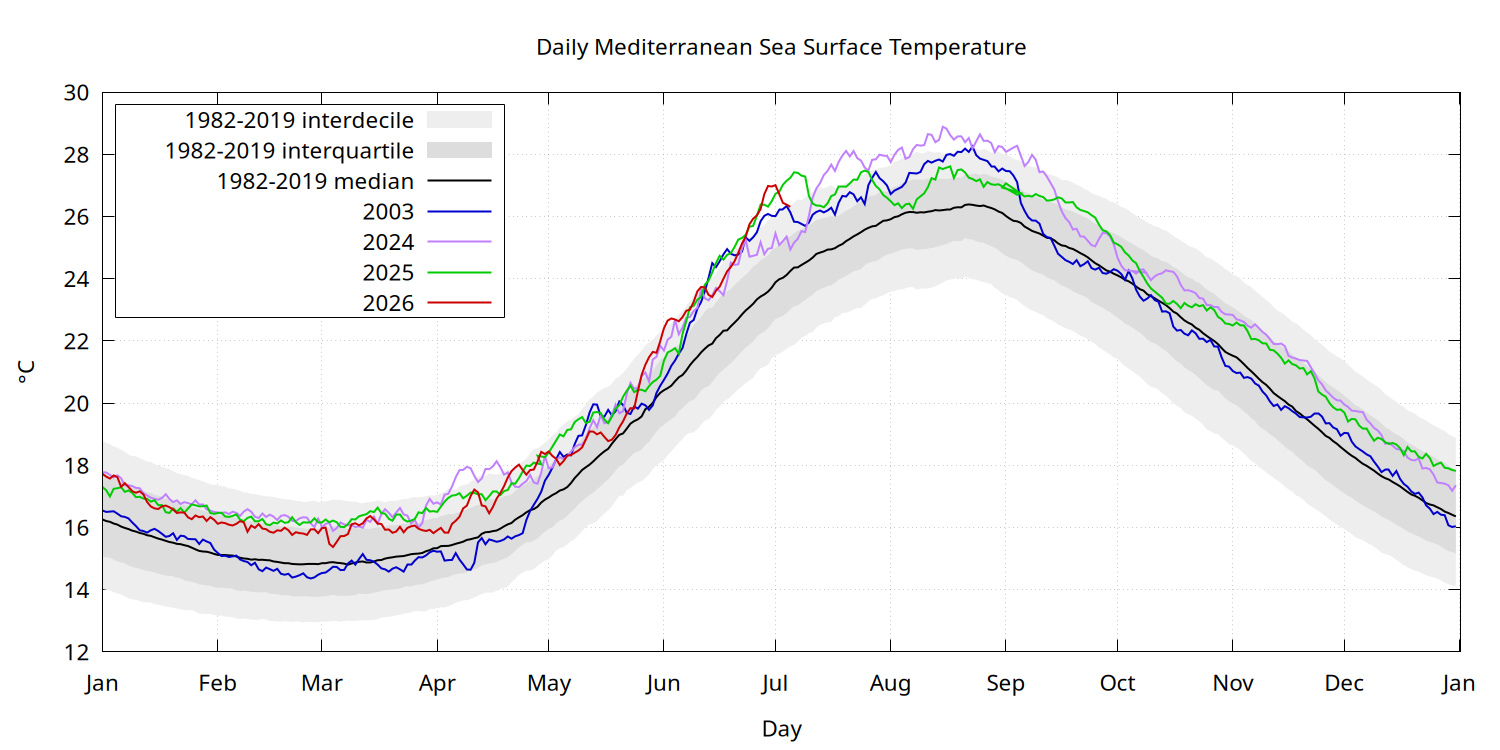
Daily evolution of the median surface temperature of the Mediterranean (raw)
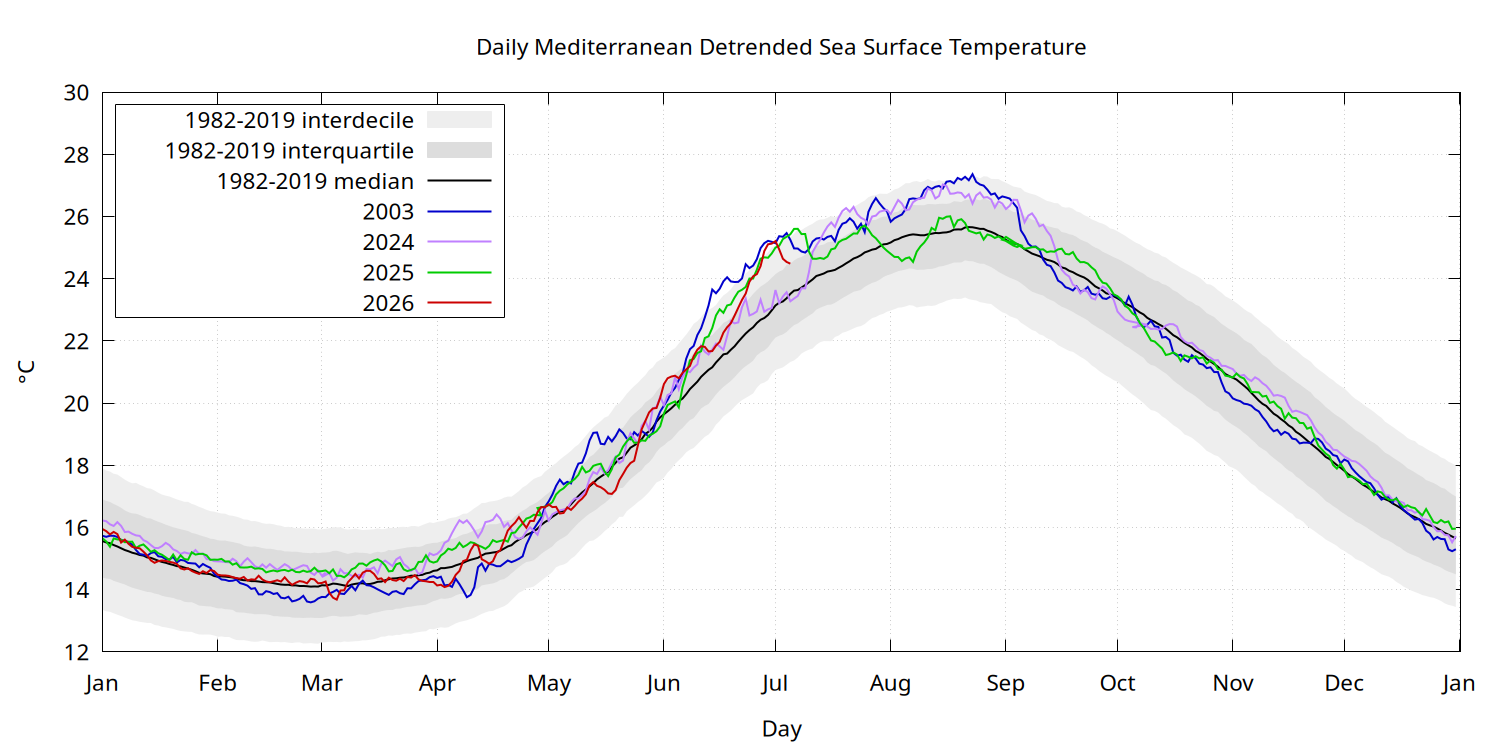
Daily evolution of the detrended median surface temperature of the Mediterranean
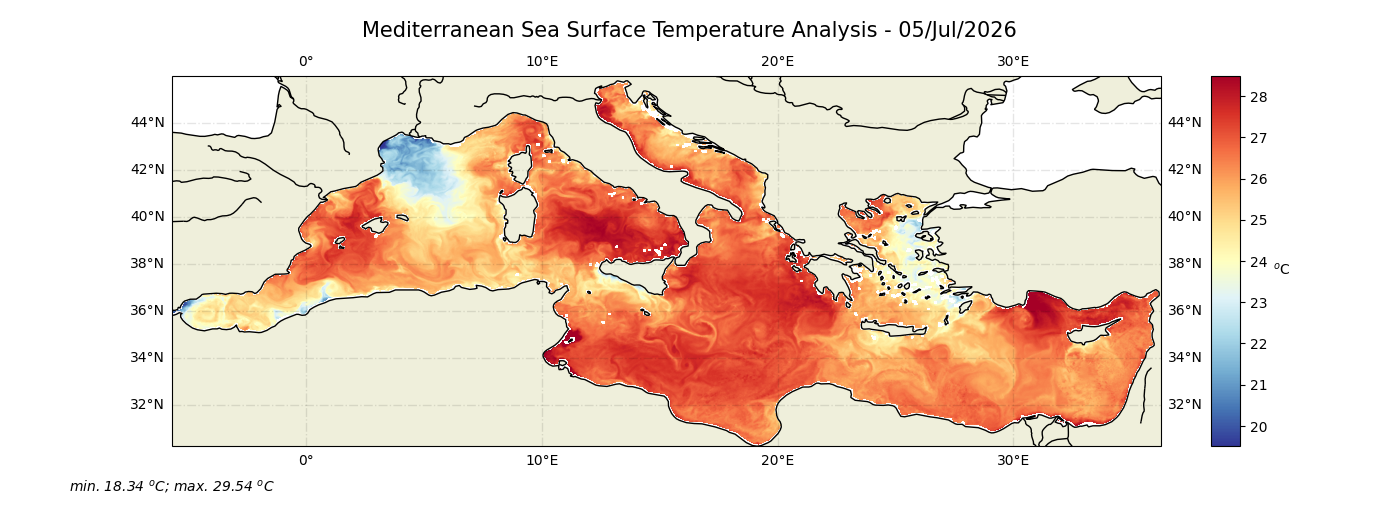
Latest sea surface temperature of the Mediterranean
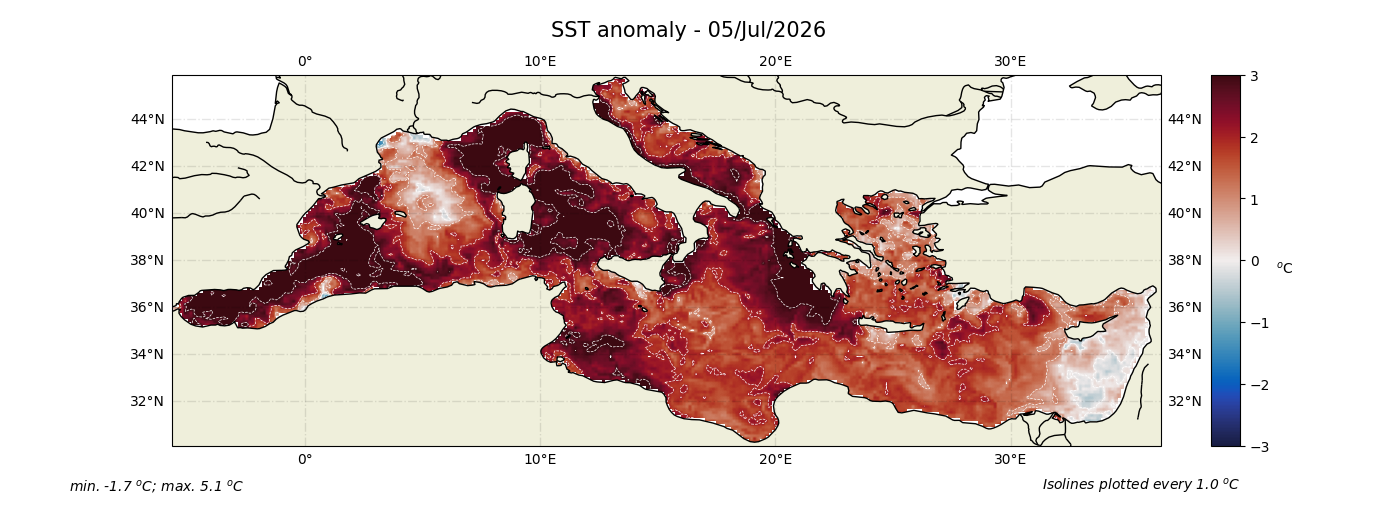
Latest temperature anomaly distribution (raw)
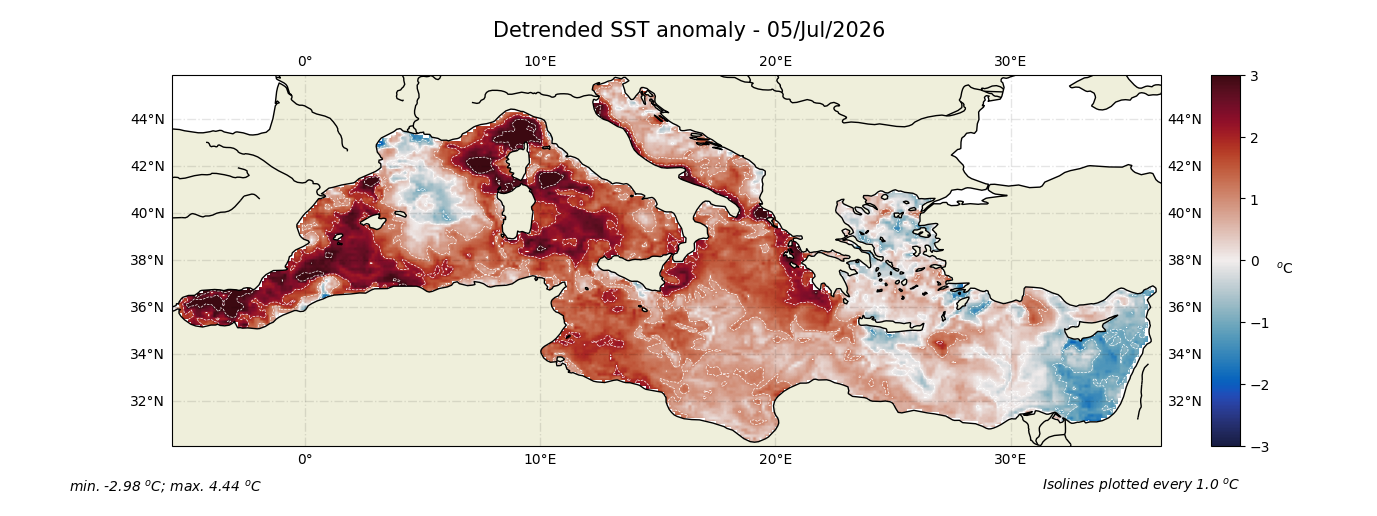
Latest detrended temperature anomaly distribution
Methodology
Marine Heat Waves — Definition
A Marine Heat Wave (MHW) is a prolonged, discrete anomalously warm water event characterised by its duration, intensity, rate of evolution, and spatial extent (Hobday et al., 2016).
An event qualifies as an MHW if all three criteria are met:
- Prolonged — the warm state persists for at least 5 consecutive days.
- Anomalously warm — temperature exceeds the local 90th percentile, computed from 38 years of historical data at every 0.125° × 0.125° grid cell.
- Discrete — separated from adjacent events by at least 2 days below the 90th percentile threshold.
The daily heat spike is defined, in MHW-affected areas, as the difference between the observed temperature and the climatological value for that calendar day.
Martínez J, Leonelli FE, García-Ladona E, Garrabou J, Kersting DK, Bensoussan N and Pisano A (2023). Evolution of marine heatwaves in warming seas: the Mediterranean Sea case study. Front. Mar. Sci. 10:1193164.
Scientific background
Time Series, Trend and Extreme Events
When a temperature record carries a significant long-term trend, classical percentile thresholds generate false positives at the end of the record and false negatives at the beginning. Removing the trend before computing climatologies ensures that detected events truly correspond to short-term extremes, not to the progressive baseline shift driven by climate warming.
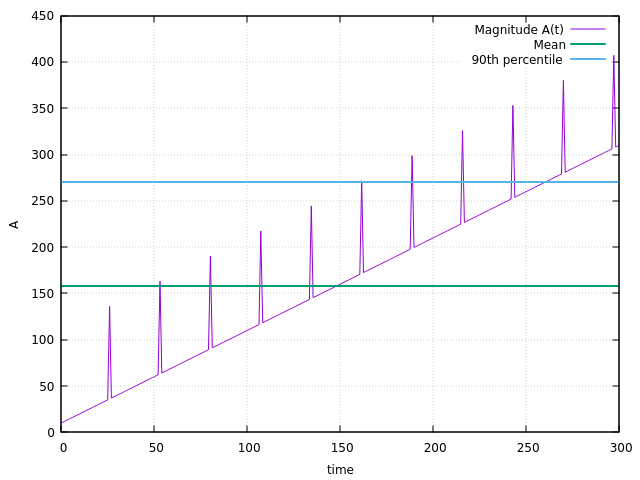
Raw time series with a positive trend — the 90th percentile (blue) produces false positives late in the record.
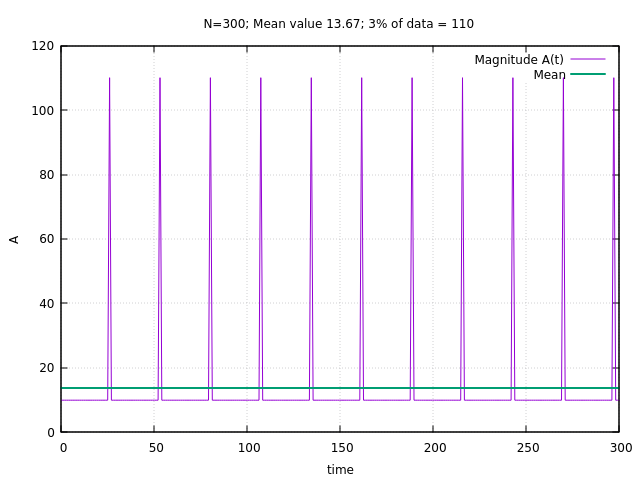
After detrending, true extreme events (peaks in the upper 3%) are identified without systematic bias.
Data sources
The Mediterranean Sea Case
Sea Surface Temperature data are provided by Copernicus Marine Service. The reprocessed product covers 1982–2021; near-real-time data extend to the present. Climatological values are derived from 1982–2019 histograms at each 0.125° × 0.125° grid cell (~14 × 11 km). The Mediterranean SST warming trend over this period reaches up to 0.68 °C/decade, confirming the basin's role as a climate change hotspot.
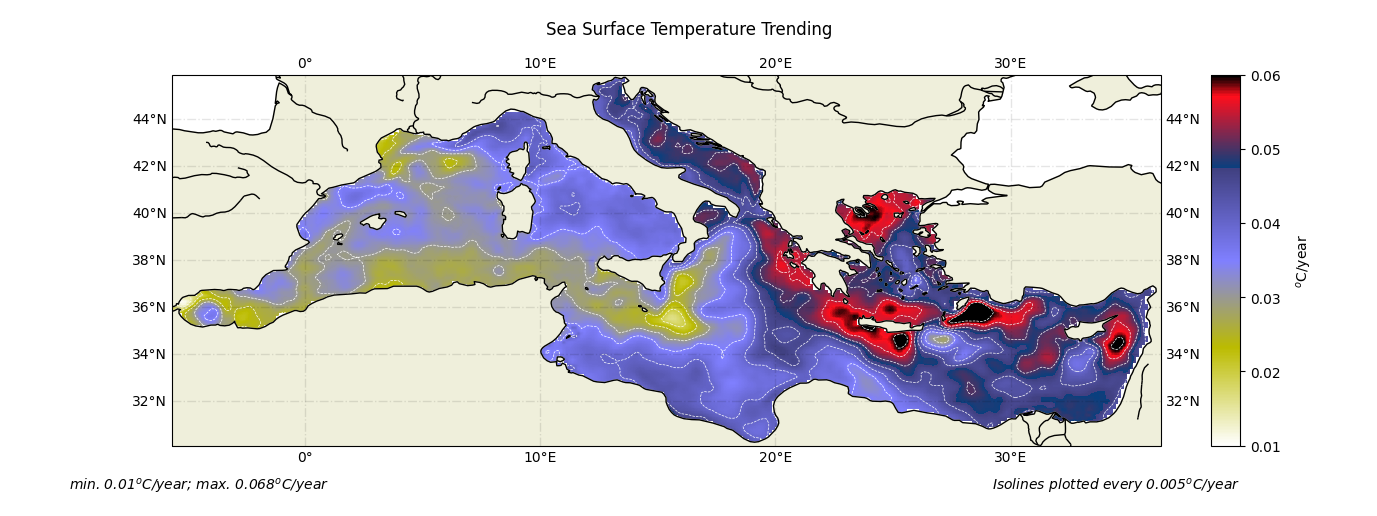
Sea surface temperature trend (°C/decade) over the Mediterranean, 1982–2019